 poolcod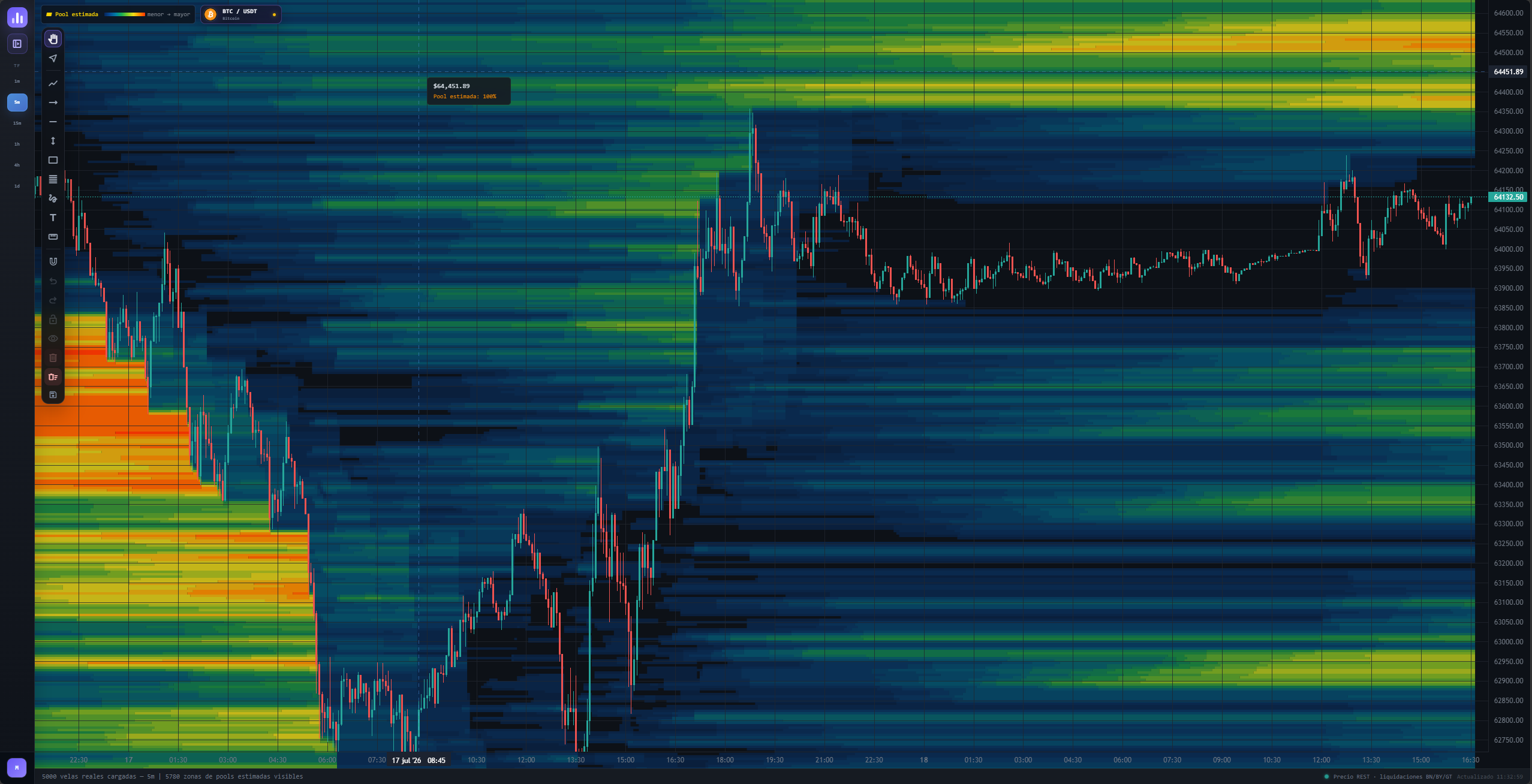
What Poolcod calculates and what Jev decides
The radar compares all 30 available markets using the same timeframe as the chart. It first calculates distance to a strong estimated concentration, imbalance between upper and lower zones, and a quality score. Estimated pools are not known positions or confirmed liquidations.
The local engine filters candidates and calculates affinity. In AI mode, the server sends Jev a summary of up to eight candidates: market, timeframe, price, zone, distance, imbalance, quality and local score. Jev can pick one to prioritize for review or abstain. A selected market moves to the top of a list of up to five candidates; not every item was picked by AI.
Jev does not invent markets outside this list, generate liquidity bands or recalculate affinity. It also does not independently set the stop or target levels used in chart drawings.
How to use AI market suggestions
- Sign in to Poolcod and open the map with active Pro access.
- Choose a timeframe: 1m, 5m, 15m, 1h, 4h or 1d. The radar and chart share that selection.
- Open Suggestions and choose Local or AI in its settings. Local analysis remains available.
- Check the source and age of the result. An AI selection does not necessarily reflect the exact price at this second.
- Open the market to compare its zones, distance and context on the chart. Independently assess whether to discard the scenario.
Affinity, quality and confidence are not profitability
Affinity combines proximity, imbalance and zone quality. It ranks model conditions: 90% affinity does not mean a 90% chance of a profitable trade.
Confidence returned by Jev describes its selection among the supplied options, not the future outcome of a trade. Poolcod does not claim a validated trading win rate for this integration. A zone can weaken, be crossed or never be reached; review the differences between liquidity zones and real orders.
How often the AI result updates
The server analyzes markets by timeframe and publishes a shared result. The following are approximate scheduled intervals, not tick-by-tick updates. Data downloads and response times may delay a cycle.
| Timeframe | Approximate interval |
|---|---|
| 1m | 4 min |
| 5m | 8 min |
| 15m | 15 min |
| 1h | 30 min |
| 4h | 60 min |
| 1d | 120 min |
For example, a 5m result is renewed roughly every eight minutes. The same coin may be selected again if it remains a candidate. An unchanged market name does not mean processing has stopped: check the result age.
The app reads the result while the suggestions view is open. Once a result reaches twice its scheduled interval without being renewed, it is no longer treated as fresh AI output and local analysis takes over. Refreshing the panel does not trigger a new Jev call.
Local mode, no candidates and AI failures
Local keeps the radar analysis independent of Jev. AI uses the server selection when it is valid and fresh. If there is no usable AI response, the app shows local analysis and keeps your AI preference so it can use the next valid result.
No candidates is not necessarily an error: when no market passes the filters, the server does not query Jev. Jev may also abstain, leaving no AI suggestion to show. The application does not force an opportunity at every update.
Shared information and analysis limitations
The current integration sends summarized market metrics from the server. It does not need to send Jev your email, password, chat ID, favorites or payment data. The provider credential is not delivered to the browser.
Poolcod uses the Jev API provided by JevTypeSafeAI. The integration does not imply an official partnership or strategy certification. It is not an execution bot: it does not open, close or manage exchange positions.
This information supports analysis and can be incomplete or outdated. It is not personalized financial advice, an entry signal or a profit guarantee. Read the Poolcod terms and privacy policy.